THE TEA SACK
01. OVERVIEW
The Tea Sack is the ceramics house of Steven Huijgens: years of work for Europe's Michelin tables through his studio Platez, until one teapot with a sack found an audience of its own on TikTok.
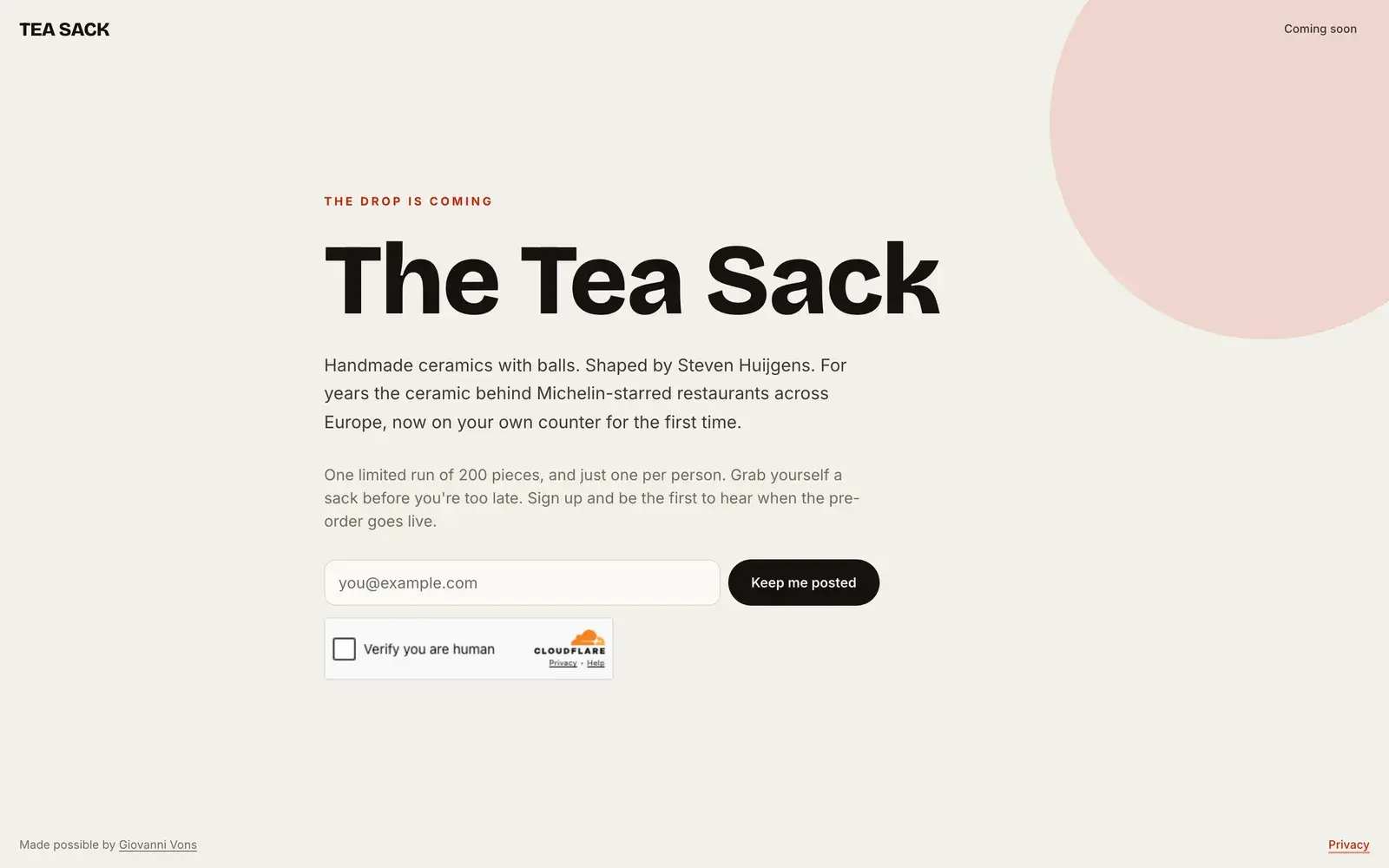
A viral moment is a door that closes fast, and the wrong shop behind it wastes the attention. The first build caught the moment: a single piece, a pre-order drop with its own checkout, a hard cap and a waitlist, live inside the window.
The second build is the house, and it starts from one decision. The joke got the world's attention; the craft is why people stay and pay; so the shop is built for the second thing without denying the first. Not a grid. A room you walk, with the machinery of a store hidden inside the architecture instead of bolted onto it.
02. THE CHALLENGE
Almost every shop convention exists for things that restock. Here most pieces exist once, so every convention had to earn its place again.
03. THE SOLUTION
Two builds. Catch the moment first, then build the house behind it, every decision in service of the craft.
The drop: one piece, one price, one promise
A single piece, one per order, a hard cap and an automatic waitlist when it filled. The page did one thing, and the checkout kept every promise the page made. It bought the time to build the house properly.
The viral moment as proof, not decoration
As seen on your FYP: two rows drifting past each other, the real reactions in one, the real comments in the other. The joke is acknowledged once, at the door, and then the room takes over.
One room, walked end to end
The store is a single walk. Each piece gets a full bay with its own composition of photographs, a numeral set deep behind it, and a caption in a deadpan catalogue register, with one wink allowed, on the flagship. You move through the work instead of filtering it.
An intro film behind one button
Start shopping is the only interactive element on landing, and scroll waits until the film ends. The threshold condenses into the small teapot and travels down to the opener with the piece centred. One entrance, so the threshold is the reveal.
The legend, turning under your finger
Only the flagship exists in 3D, drag to turn, because the object that started everything deserves to be held and every other piece in 3D would have diluted that. The model was slimmed until it lands before a visitor thinks to wait.
The plaque, and the room behind it
A plaque follows you down the wall with the piece you are standing at, its record and one action. Opening it slides in a viewing room with every photograph, the full record and the buy, while the wall stays where it was, so you never lose your place.
Sold, choreographed
When a piece goes, its bay reveals differently: a veil rises and leaves the object's shadow behind, SOLD stamps in, and the plaque swaps its buy for a tag. It runs off real stock, and the maker adds new work himself, so the wall stays true without anyone touching the site.
04. RESULTS
The room opened in August 2026, and the wall started changing on its own the same afternoon.
The wall keeps itself honest
Pieces sold on opening day, and each one flipped to its sold state with nobody editing a page. Scarcity here is not a badge. It is the actual stock, rendering itself.
Readable by assistants too
The room is built for people, and the facts under it, titles, materials, editions, prices, are served in the form an AI assistant reads, so the shop is found as well as felt.
Runs without me
Names, prices, stock and the extras shelf are the maker's to change from the back office. My part is finished, and the room updates itself.
Room for the next kiln opening
The walk is built to take a drop. New bays slot into the same choreography, and the reveal machinery deliberately left parked at launch is ready for a release that deserves a curtain.
The joke got the world's attention. The craft is why people stay and pay. The shop had to be built for the second thing without wasting the first.