THE ANSWER REPORT
01. OVERVIEW
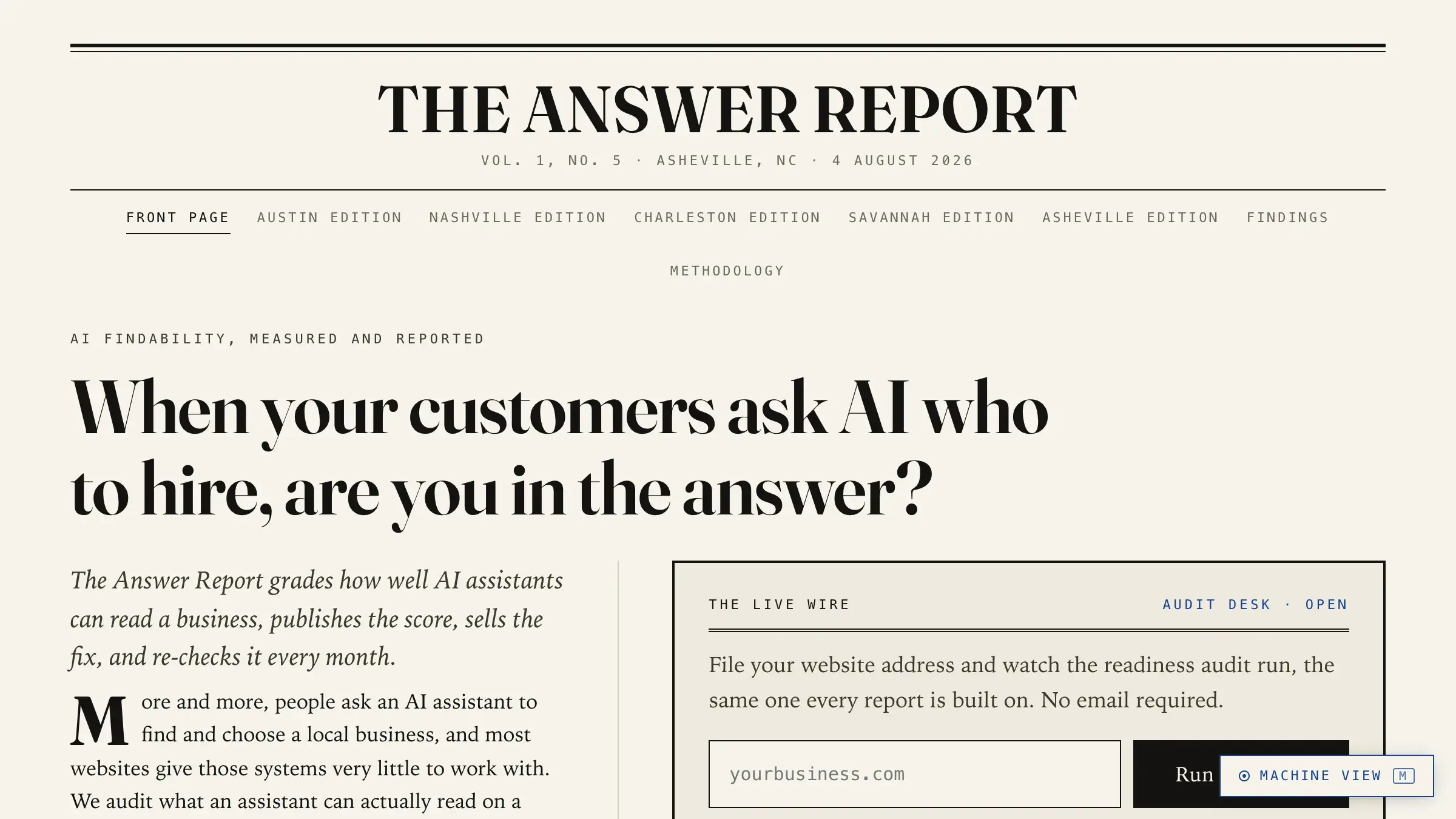
The Answer Report measures how well an AI assistant can read a business website, publishes the score, and sells the fix.
More and more people ask an assistant who to hire before they open a search box. I measured what that means. Between 17 and 30 July 2026 I asked two AI engines the questions engaged couples ask, in three American cities: 153 of the 173 local wedding businesses I tracked were never named in any answer. In the Dutch province of Utrecht I asked 840 times for an installer, and none of the 70 businesses I tracked appeared in a single answer.
So I built the instrument. A deterministic engine scores a site from 0 to 100 on what an assistant actually reads, a newspaper publishes those scores one city edition at a time, and a paid report turns the score into a step plan a web developer can work through. Ten editions are out, the engine grades my own sites in public, and since 4 September 2026 the same engine runs a €99 website audit for Dutch businesses.
02. THE CHALLENGE
A product that grades other people has to be unarguable, so almost every decision here is a decision about trust.
03. THE SOLUTION
One product in three layers: the engine that measures, the publication that carries it, and the rails that run both.
The engine, and the rule that keeps it stable
Twelve weighted checks in four categories: access (30), facts (25), legibility (30) and contactability (15), summed to a score out of 100. A pass earns the full weight, a warning half, a failure nothing. The rubric is pinned: any change to a weight or a threshold bumps the version, and a score is only ever compared with a score from the same version.
A newspaper, not a dashboard
The findings publish as a publication: volume and issue, a front page, one city edition per cohort, findings pieces with the stored answers behind every number, four guides and a methodology page. Ten editions so far, nine wedding markets and one home-services market. Behind the piece on directories sit 5,904 stored answers. Any listed business can ask to be removed, and is.
The machine view
Any page on the site flips, with one control or the M key, into exactly what an AI reader receives: the facts it is served, the access rules, the bare text. The product proves its thesis on its own pages.
An open audit desk that cannot be abused
The free audit runs the same engine, live, against the address you file. Public addresses only; private and internal ones are refused; three free runs a day per visitor; one job at a time behind a hard timer. No visitor path reaches the expensive part of the pipeline.
The paid report, and the person who reads it
The full report is $149 one time and monitoring $29 a month. Since 4 September 2026 there is also a Dutch website audit at €99, delivered as a page in four parts: AI findability, what a visitor runs into, Google findability, speed and technical health, with a step plan per point. Giovanni reads every Dutch report before it goes out, within two working days.
The calibration pass
On 4 September 2026 four €99 reports were written by hand against real sites before the rail went automatic. Every one was rewritten: 24 machine findings dropped, 21 corrected, 47 added. Six engine defects came out of it and were fixed the same day, among them a speed score stated from a single sample. The published example report is one of the four, anonymised, score 61.
It runs itself
Auditing, publishing and delivery run on their own schedule on their own machine, with a watchdog that raises an alarm the moment serving looks wrong. The standing rule: nothing that earns money depends on a laptop being open.
04. WHAT IT DOES NOW
The engine grades my own work in public, and the numbers have started doing the arguing.
It publishes its own score
The engine gives theanswerreport.com 93 out of 100. The missing points are a phone number the publication does not have. Rather than invent one, the correction is printed on the front page.
It changed how I build websites
The first self-demonstration took vonzie.studio from 60 to 93 in July 2026: a hosting-layer default had been silently blocking AI crawlers and hiding the contact address. In the fleet sweep of 31 July, 26 live sites averaged 74.2 against 72.3 for the 182 businesses I was emailing about the same problem, and vonzie.studio went to 100 that day. Since then no site leaves the studio unmeasured.
A Dutch example anyone can read
The public example at audit.vonzie.studio/voorbeeld is a real audit with the identifying details replaced, not an invented business: score 61, twelve findings, measured on 4 September 2026. The business was not asked and is not named, which is exactly why it is anonymised.
A city at a time
Adding an edition is a data step, not a development step, so the publication grows by cities. The rung above the €99 report is the fix work itself, at a fixed price per item.
I wanted an instrument, not an opinion. If a score is going to cost someone money to fix, it has to come out the same every time and it has to show its evidence, starting with my own.