LOVE GOGGLES
01. OVERVIEW
Love Goggles sells one thing: a Y2K digital camera that shoots the grainy, flash-lit photos a phone refuses to take. It needed a store that sells it without a developer in the loop for every order.
On 7 July 2026 the store was a stock template with empty pages, a product description pasted in from another platform, and a page that promised free shipping while the checkout charged A$9.
On 9 July it was live on lovegoggles.com.au: a brand layer of my own over the template's commerce plumbing, a homepage that is the buy page, one product at one price, a checkout that matches the page to the cent, four policies written to Australian Consumer Law, and a catalogue AI shopping assistants read as accurately as people do.
02. THE CHALLENGE
A generic shell had to become a branded store that sells one product and keeps every promise between the page and the checkout.
03. THE SOLUTION
Own every pixel a shopper sees, collapse the purchase to one decision, make the checkout keep the page's promise, and serve machines the same facts as people.
A brand layer of my own
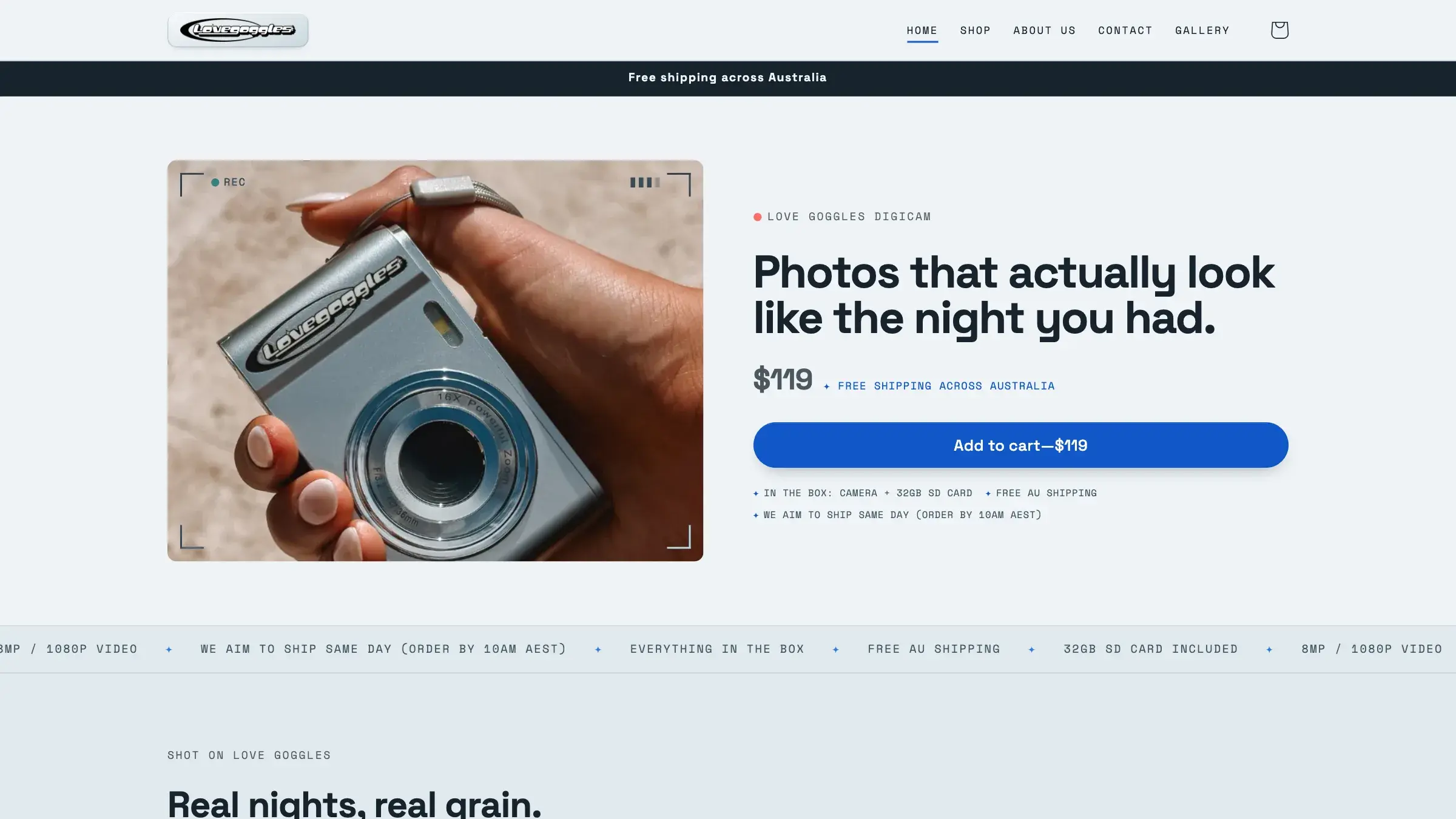
Four directions were built out and one won: ice, chrome and cobalt, self-hosted type, and a viewfinder HUD with a REC dot and corner brackets, lifted straight from the product. Thirteen sections of my own; the template keeps only the plumbing, the cart and the checkout.
The homepage is the buy page
Image, headline, price and add-to-cart in the first screen on a phone. Below it, the photos shot on the camera itself, how it works, what is in the box, the specs and the FAQ. A sticky buy bar follows once the form scrolls away, and the product page mirrors the homepage.
One product, one price
The two cable variants were merged into one; the add-on was dropped. What remains is two taps from landing to checkout. On 19 July a wallet button went in under add-to-cart, for a phone-first audience that wants to pay in one tap.
A checkout that keeps the page's promise
Standard shipping across Australia set to A$0, express to A$14.99, and the price set so the checkout total matches the page to the cent. Four policies written to Australian Consumer Law, live from 9 July 2026. Since 3 September a 30-day guarantee sits in the policy, the buy box and the FAQ, word for word the same.
Copy that sells the feeling, then the facts
The headline: "Photos that actually look like the night you had." Every claim on the site traces to one claims table: real specs, "I aim to ship same day" instead of a hard promise, no invented was-price. Since 10 July 2026 the store shows fourteen photos genuinely shot on the camera, four on the homepage and eight in the gallery.
Readable by shopping assistants
The business, the site and the product described in the form shopping assistants read, the product on the homepage too, every assistant welcome, a description and image text on every page. Measured with my own Answer Report: 77 of 100 on 31 July 2026, 93 on 3 September. The product page's search score went from 92 to 100.
04. RESULTS
Live since 9 July 2026, and running without a hand on it since.
Live and selling on its own domain
On lovegoggles.com.au since 9 July 2026. Orders run from cart to checkout without a developer per order.
The page and the checkout agree
Free shipping is free at checkout, the price on the button is the price on the receipt, the guarantee is in the policy, and the policies are correct for Australian Consumer Law.
Read by machines as well as people
93 of 100 on AI readability, measured 3 September 2026, the ceiling for a store with no public phone number. The price and availability an assistant reads follow the live product, so an assistant never quotes an old price.
Shipping beyond Australia is a switch
The store sells in Australia only, on purpose. A worldwide market at a flat rate is specified and can be turned on without a rebuild, the day the founders decide to.
A store that sells one thing has one job: make the buy obvious and keep every promise between the page and the checkout. Two days to build, and it has run on its own since.