DOOMSCROLLERS
01. OVERVIEW
A coaching business is one job only she can do and nine she should not have to.
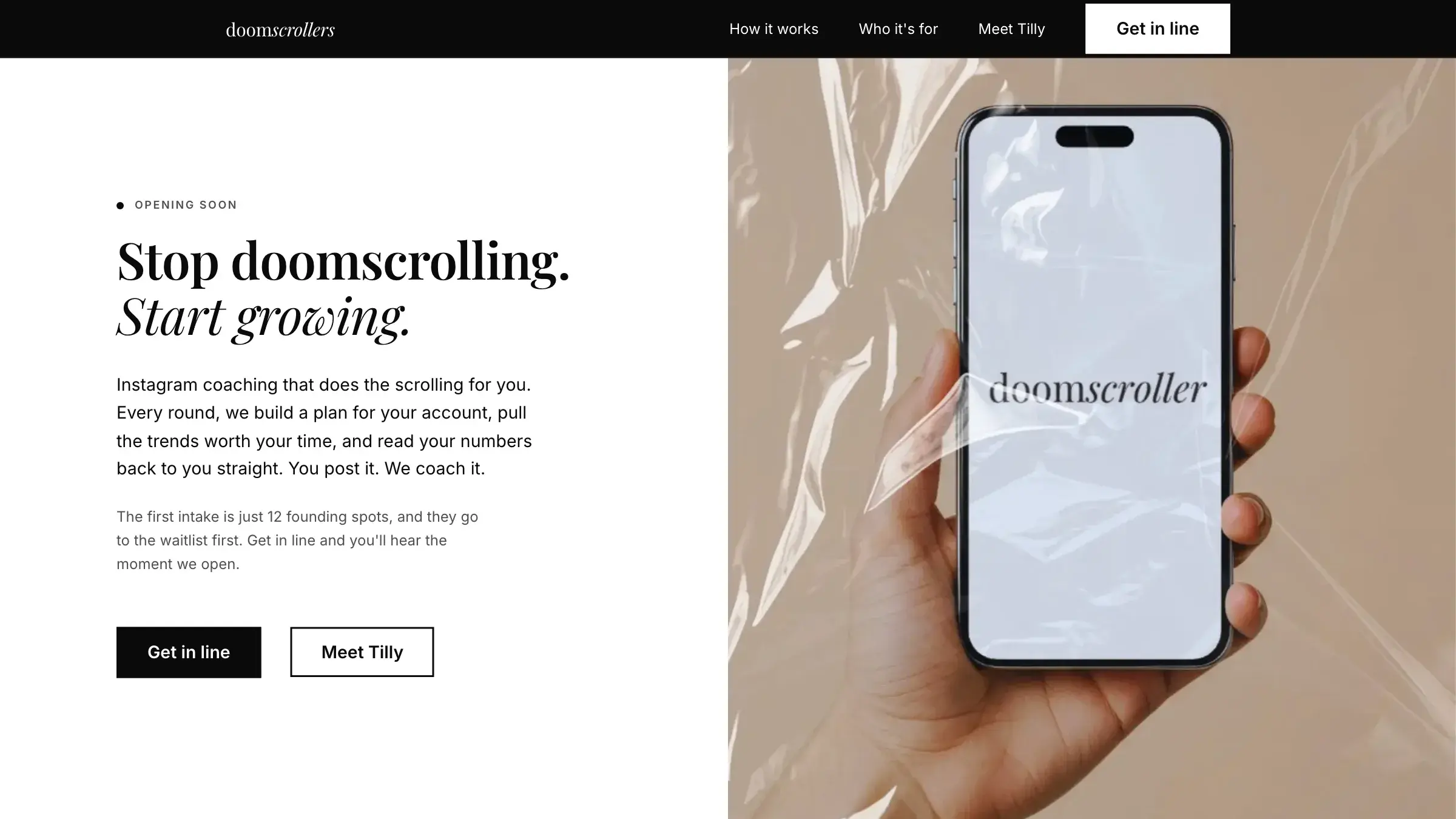
Doomscrollers sells three things: a written audit of your Instagram for A$300, back within five business days; the Scroller Social Club, a plan for your account every fortnight from A$160; and a A$50 Handbook that carries the method. One coach reads the account and writes the plan.
Everything else is a rail: taking the money, onboarding, the check-ins, the first draft, the email, the calls, the search presence, the outreach, the books. I built each of them and runs the ones that are not coaching. The site went live on 19 July 2026 and something new has shipped almost every week since.
02. THE CHALLENGE
The hard part was never the sales page. It was making one person's business behave like a team without hiring one.
03. THE SOLUTION
Every rail a coaching practice runs on, built around the one job only she can do.
A brand with a rulebook
Club maroon on ivory. Every visual device is one component, the design book renders it by import, and the build fails the moment a page draws its own copy of one. The homepage opens on a television that doomscrolls a week of contradicting advice; on the calm channel, the fortnight's plan.
A front door that costs A$300
The Scroller Social Audit: a 22-question intake, a written read of the account within five business days, and every dollar back if she has not started. In a scan of thirteen competitors it sits in the market's basic price band with a premium deliverable, and it is the only one with a real example to read before you buy.
Money first
A member exists because a payment cleared: the membership is created and the welcome sent the moment the money is confirmed, once. Every price lives in one place, so a repricing is an afternoon, not a rebuild. Underneath, a ledger keeps one line per charge and checks itself against the payment processor every night. A clean night is silent.
The plan engine
Every plan starts as a draft written from the member's own check-in, their uploaded insights and, since 4 September, the posts they actually published. About three minutes a draft. In the September benchmark, the run with the real grid in front of it found two things the hand-written plan had missed. The coach edits with the member's words beside her.
The Coach's Desk
Plans, audits, money, clients and the rest on five tabs, opening on what needs her next. A dossier per member, calls booked into her own availability, an audit queue with its own clock, and a money view of collected against expected, one-off sales and GST. Insight only: nothing on it moves money.
Email on events, not on a drip
Welcome, plan published, check-in due, call reminder, audit delivered: every send fires on the thing that happened and leaves through one door, so a hold, a reply-to or a test guard covers every sender at once. Behind the free guide, the checklist and the Plus waitlist sit three nurture sequences, nine emails, written in her voice.
Findable by people and by assistants
Six guides, each one Instagram question answered the way she would answer it on a call, each ending at the audit. Every page carries the facts an assistant reads, and every assistant is welcome to read them. On my own findability engine the site went from 72 out of 100 on 31 July to 93 on 16 August, and has held 93 on every read since.
04. RESULTS
Live since 19 July 2026. The first audit sold on 22 August; the Handbook went on sale on 23 August.
Selling on four rungs
A free guide and a free checklist for an email address, the A$50 Handbook, the A$300 audit and the Club from A$160 a fortnight, every price served from one file.
Drafting in minutes, publishing on purpose
The engine drafts from the member's check-in, insights and grid in about three minutes; the coach edits; a publish pinned to its version can never email a member twice.
Measured, not guessed
93 out of 100 findability, six guides indexed, a ledger that reconciles nightly, three testimonials on the audit page, and a feedback form that stores nothing about who sent it, so anonymous means anonymous.
The same rails, more products
The rails are built once. The next product sold through the same checkout, email and desk costs a page, not a build.
The coaching is the one job only she can do. Every other job in the business is now a rail she does not have to think about.